For years, coordinator assignments at Highlands Oncology Group came down to judgment calls. This is how the research team replaced three generations of manual workload tools with real-time acuity data, and what changed once leadership could see the numbers.
RACHEL RICHMOND, RN | Clinical Research Manager, Highlands Oncology Group | TRIALNAV OASIS™ Workload Acuity | Staffing & Forecasting
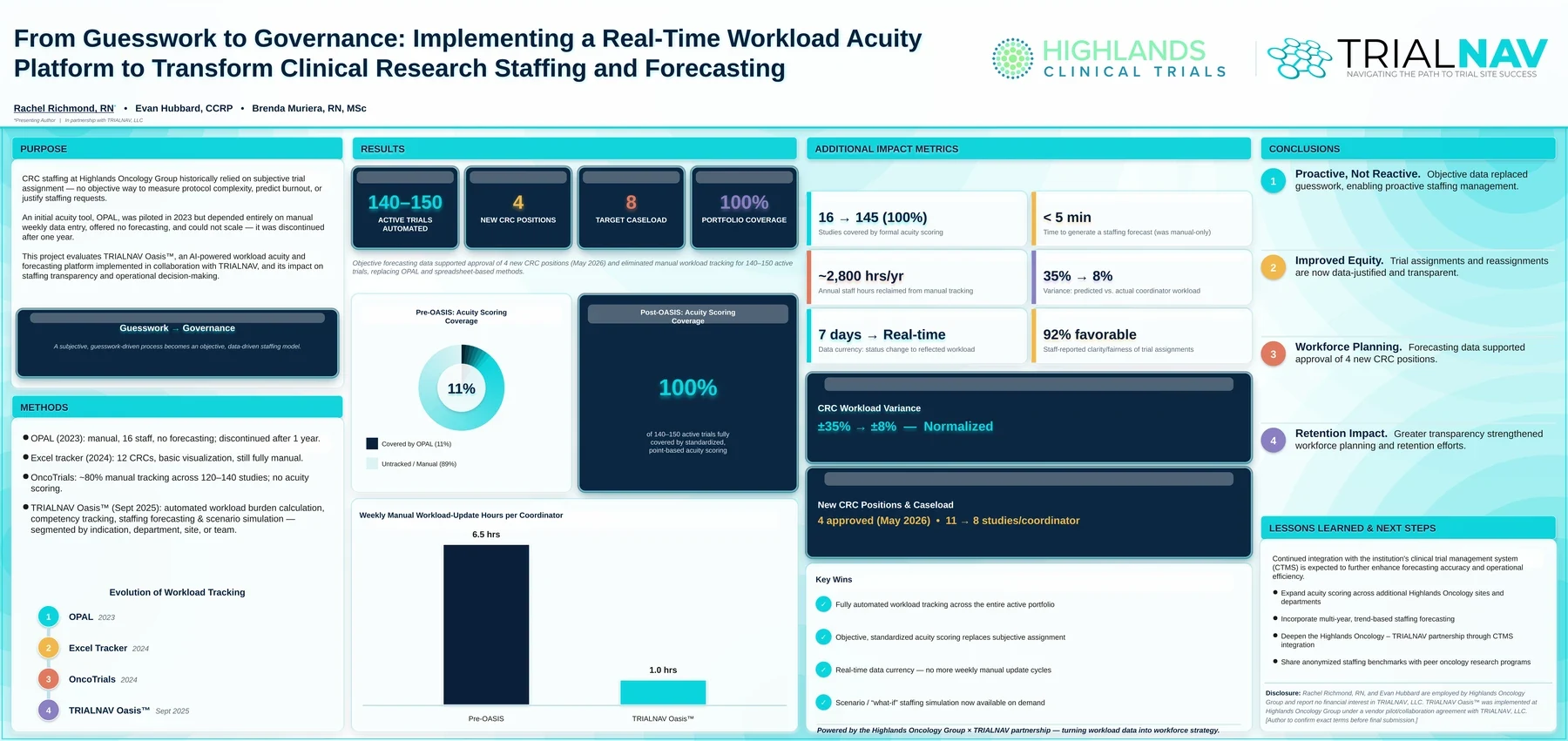
This article is based on the poster of the same name, presented at SOCRA 2026.
The problem: staffing by feel
Clinical research coordinator (CRC) staffing at Highlands Oncology Group historically relied on subjective trial assignment. There was no objective way to measure protocol complexity, no way to predict burnout before it happened, and no data to justify a request for more staff.
Most research leaders will recognize what follows from that. Assignments get debated instead of decided, coordinators carry workloads nobody can fully see, and every staffing request becomes a question of trust rather than evidence.
Three tools, three lessons
Before TRIALNAV OASIS™, the team worked through three different approaches to tracking workload. Each one solved part of the problem. Each one eventually hit a wall.
2023: OPAL, the first acuity tool
OPAL was introduced in January 2023 and took about a month to build. It supported only 16 staff members and relied entirely on manual weekly updates. It offered no forecasting or scenario simulation, and it could not scale across the program's full study portfolio. After one year, the maintenance demands had become unsustainable, and the tool was discontinued.
2024: an Excel-based tracker
In December 2024, the team built a spreadsheet tracker in two weeks to support 12 CRCs during a transition to indication-focused assignments. It added basic visualization, but every data point was still collected by hand, and it had no forecasting capability.
OncoTrials: better reporting, the same manual burden
A third system, OncoTrials, made it possible to report on patients and studies per CRC and principal investigator. But roughly 80% of workload tracking remained manual across 120 to 140 studies, with no trial acuity scoring and no forecasting.
The pattern was clear. Each tool reduced some of the manual effort, but none could answer the questions that actually drive staffing decisions: How heavy is each study? Who is at risk of overload? How many coordinators will the program need next?
Implementing TRIALNAV OASIS™
In September 2025, Highlands Oncology Group deployed TRIALNAV OASIS™, an AI-powered workload acuity and forecasting platform, in collaboration with TrialNav. It replaced the earlier tools with:
- Automated workload burden calculation at both the staff and study level
- Real-time competency tracking
- Staffing forecasting and scenario simulation
- Views across the full study portfolio, segmented by indication, department, site, or team
Together, these closed exactly the gaps that had limited OPAL and its successors: scalability, forecasting, and automation.
The results
As of January 2026, TRIALNAV OASIS™ had eliminated manual workload tracking for 140 to 150 active trials, fully replacing OPAL and the spreadsheet-based methods.
The impact went well beyond saved hours:
- Four new CRC positions approved in May 2026, supported by objective forecasting data generated through the platform
- Progress toward a target caseload of eight studies per coordinator
- More transparent staffing discussions with the CRC team
- Objective justification for trial assignments and reassignments, replacing a previously subjective, guesswork-driven process
From reactive to proactive
Moving from manual, time-intensive tools to an AI-powered acuity and forecasting platform changed how staffing is managed. Instead of reacting once coordinators are already overloaded, the team can plan ahead.
The platform now provides objective data to support staffing requests, improves equity in how trials are assigned, and strengthens workforce planning and retention efforts.
What comes next
Highlands Oncology Group is continuing to integrate TRIALNAV OASIS™ with its clinical trial management system (CTMS), which is expected to further enhance forecasting accuracy and operational efficiency.
Takeaways for research leaders
- Manual tools can prove the need, but rarely scale. OPAL, the spreadsheet, and OncoTrials each showed the value of workload data, and each ran into the limits of manual upkeep.
- Forecasting is what turns workload data into a staffing case. Current workload tells you where you are. A forecast tells leadership what you will need.
- Objective data makes assignment conversations easier for everyone. When workload is measured the same way for every coordinator, decisions become transparent instead of personal.
About Highlands Oncology Group:
Highlands Oncology is an independent, physician-owned cancer center serving Northwest Arkansas and the tri-state region. Through six locations, Highlands provides comprehensive oncology services including medical, radiation, and surgical oncology, clinical research, imaging, infusion services, rehabilitation, a pharmacy, and a host of supportive care programs. Highlands Oncology remains dedicated to delivering innovative care with precision and compassion.